
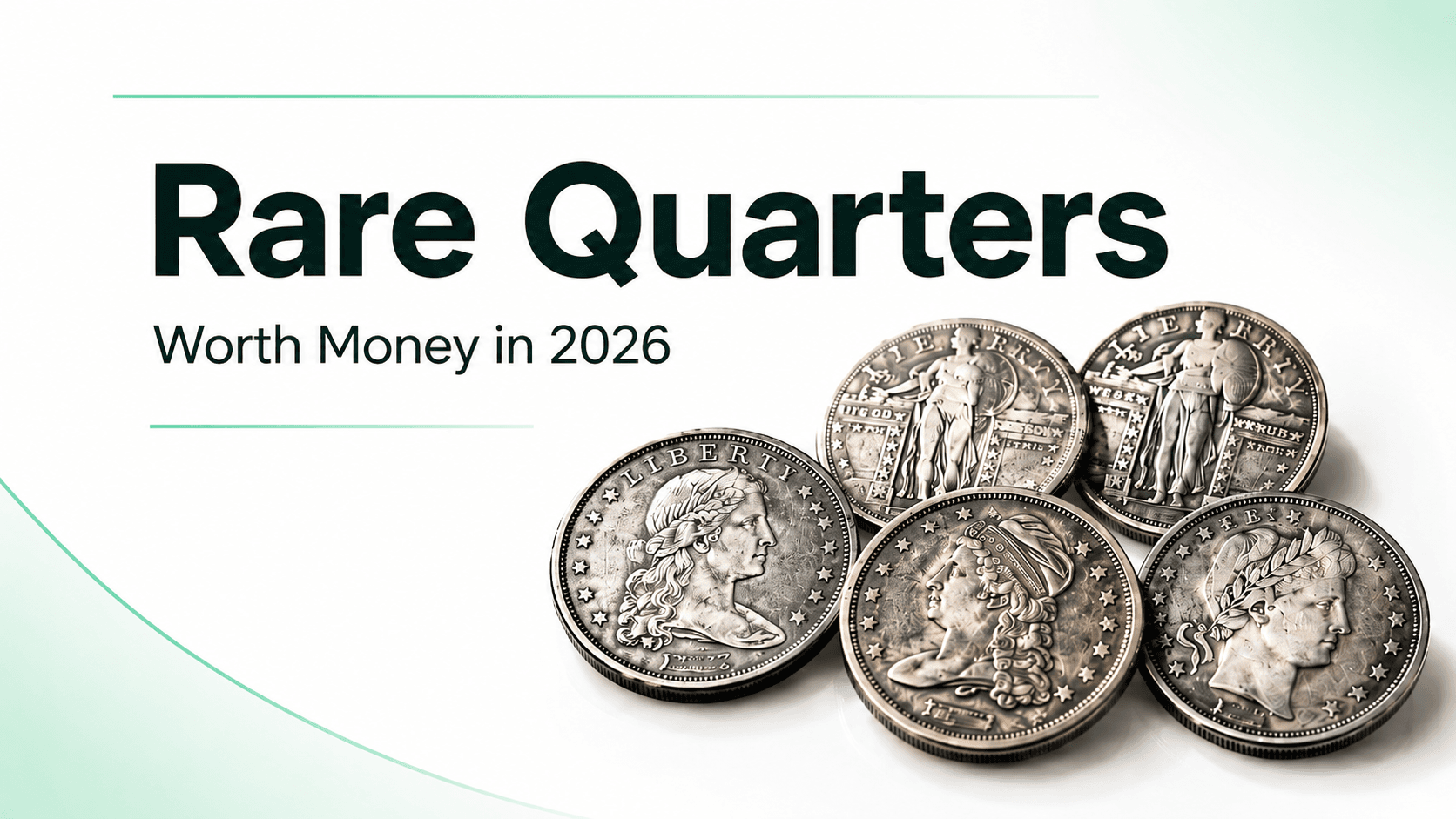

Most lists like this are full of coins you will never see in your change. That is half true. The biggest names here live in auction catalogs and museum cases, and a worn example still costs more than a car. But a few of these really do turn up in circulation, and people pull them out of rolls every year.
A note on the numbers before we start. Every value below is what real examples have sold for, at auction or through dealers, and coin prices swing hard with grade and eye appeal. A beat-up coin can be worth a tiny fraction of a pristine one of the same date. Treat these as the high end, not a price tag, and read it as coin history, not investment advice.
The blue-chip rarities
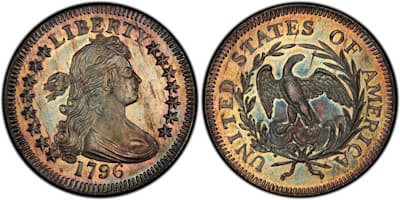
1. 1796 Draped Bust quarter. The first quarter the United States ever struck. About 6,146 were made and fewer than 700 survive, so this is a rarity in any grade. A worn one in Fine runs around $50,000 to $60,000, an About Uncirculated example can hit $145,000, and the finest known, a gem MS66, sold for $1.7 million.
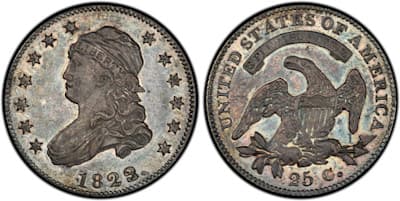
2. 1823/2 Capped Bust quarter. One die pair, an overdate, and maybe 33 coins left in the world. Most that survive are heavily worn, and even those are five figures. A regular-strike example brought $246,750 in 2015. If you owned one, you would know.
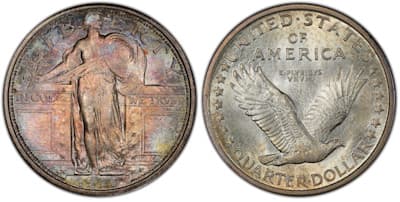
3. 1918/7-S Standing Liberty overdate. A working die took impressions from both a 1917 and a 1918 hub, leaving a faint 7 under the 8. Fewer than a thousand are thought to survive. Well-worn, it is worth around $2,700. Uncirculated, it jumps to $23,000 and up, and gem examples are nearly impossible to find.
4. 1916 Standing Liberty quarter. First year of the design, and only about 52,000 struck, which makes it the key date of the series. The record is $336,000 for a pristine full-head example. One authentication point worth knowing: a genuine 1916 has no stars beneath the eagle on the back. The three-star reverse did not arrive until mid-1917, so any 1916 with stars is a fake.
5. 1901-S Barber quarter. The most sought-after Barber quarter of all. Even a well-circulated Good-4 starts in the high three thousands. It is also one of the most counterfeited US coins, usually by grafting an "S" mint mark onto a common Philadelphia 1901, so this is a coin you never buy raw. Certification is not optional.
6. 1932-D Washington quarter. The Washington quarter debuted in 1932, and Denver struck very few. Circulated examples run into the hundreds, a nice MS65 is around $12,000, and the auction record is $143,750 for an MS66 back in 2008.
7. 1932-S Washington quarter. The other 1932 key date. A touch more common than the D, but still scarce. MS65 sits near $3,000, and a top MS66 reached $45,500 in 2020.
Ones you could actually find
8. 1965 silver transitional error. In 1965 the Mint switched quarters from silver to copper-nickel, and a few got struck on leftover silver blanks by mistake. You catch it with a scale, not your eyes: a normal clad quarter weighs 5.67 grams, a silver one weighs 6.25. The error sells in the range of $4,000 to $7,000.
9. 2004-D Wisconsin "Extra Leaf" quarter. A die flaw added an extra leaf to the corn on the Wisconsin state quarter, in two versions, High and Low. Thousands exist and they still surface in change, with most selling somewhere between $50 and $150 depending on the variety and grade.
10. 2019-W and 2020-W West Point quarters. These are the ones to actually watch for right now. In 2019 the Mint put a "W" mint mark on circulating quarters for the first time ever, about two million of each of the five designs, and in 2020 it did it again with a small "V75" privy mark to the left of Washington, marking the 75th anniversary of the end of World War II. They went straight into circulation, so they still turn up in change and rolls. Condition drives the price, but a found one generally runs from a few dollars into the low tens, a bit more for a clean 2020 with the privy mark.
How to tell if yours is the real thing
Stamps and dates can be faked, mint marks can be added, and a value guide only matters if the coin is genuine. A scale settles the 1965 silver question in seconds. The 1916 stars and the 1901-S mint mark are known counterfeit tells. For anything in the four-figure range and up, a raw coin is a gamble, and serious money only changes hands on coins that a grading service like PCGS or NGC has already authenticated and slabbed.
That last part is the whole game with key dates. On Pure, every coin is verified before it trades, and you can buy and sell certified coins on an open order book where you name your price instead of taking a dealer's. If you think you have one of these, get it authenticated first, then you will actually know what you are holding.
FAQ
What is the rarest quarter?
By survival, the 1823/2 Capped Bust quarter, with around 33 known. The 1796 Draped Bust is the most famous early rarity, and the 1918/7-S overdate is the toughest of the 20th-century quarters in high grade.
Are any valuable quarters still in circulation?
A few. The 1965 silver transitional error (catch it by weight), the 2004-D Wisconsin extra-leaf varieties, and the 2019-W and 2020-W West Point quarters all turn up in change and rolls. The famous key dates were pulled from circulation long ago.
How do I know what my quarter is worth?
Grade and authenticity decide almost everything. The same date can be worth $50 worn and thousands uncirculated. For any coin that might be a key date, get it graded by PCGS or NGC before you trust a number.