
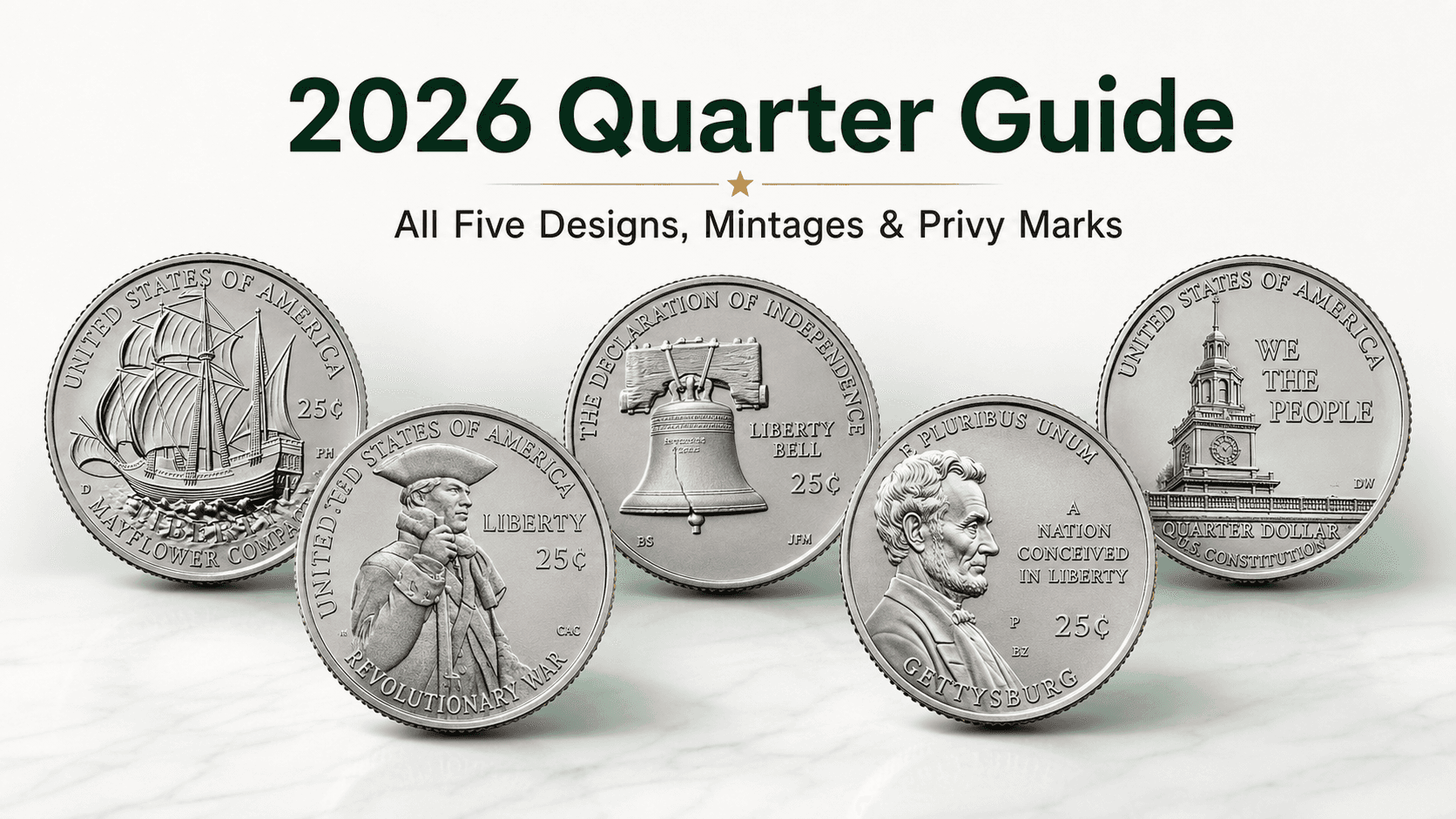

The quarter in your change might not have George Washington on it. For the first time since the Standing Liberty quarter ended in 1930, circulating quarters are appearing with someone else on the obverse.
The US Mint is issuing five different quarters in 2026 for the country's 250th anniversary, and each one carries its own obverse and reverse. Four of the five are out. Every design is dual-dated 1776 ~ 2026. Officially the 2026 quarters belong to the semiquincentennial program, the same umbrella that covers this year's redesigned dimes, half dollars, and gold and silver commemoratives. The quarters are the piece of that program most people will actually touch, which is why they get their own guide.
The five designs
Washington has anchored the quarter's obverse since 1932 while the reverse rotated through states, parks, and notable women. In 2026 the Mint flipped the arrangement: the subject changes on both sides, and Washington appears on just one of the five coins.
Mayflower Compact opened the series in January. Two Pilgrims on the obverse, the Mayflower under sail on the reverse, sculpted by Phebe Hemphill. It marks the 1620 shipboard agreement that gets taught as America's first written framework for self-government.
American Revolutionary War followed in late March, and it's the one coin that keeps Washington, on the obverse. The reverse shows a Continental Army soldier at Valley Forge.
Declaration of Independence drove this year's headlines. Thomas Jefferson on the obverse, the cracked Liberty Bell on the reverse. A lot of people go looking for it as the "2026 Liberty Bell quarter" or the "2026 Liberty quarter," neither of which is its name. It began reaching banks on June 1, and the Mint's direct products followed two weeks later.
U.S. Constitution entered circulation on August 10, 2026, when the Mint started shipping it to Federal Reserve Banks. James Madison takes the obverse, from a portrait Joel Iskowitz designed and Don Everhart sculpted for the 2007 Presidential dollar. Donna Weaver designed the reverse and Phebe Hemphill sculpted it: Independence Hall, WE THE PEOPLE above the roofline, and the steeple clock set to 2:50 as a nod to the 250th.
Gettysburg Address closes the year. Abraham Lincoln on the obverse, and on the reverse two clasped hands with "a new nation, conceived in liberty" in the field. The Mint hasn't published a firm date, so late October is a working window and not a promise.
A full reference table sits at the end of this post.
How the mintages actually break down
Through July the Mint had struck 189.6 million Declaration of Independence quarters, 126.6 million of those in Denver alone. Mayflower ran higher. So did the Revolutionary War coin.
Design | Denver | Philadelphia | Struck through July 2026 |
|---|---|---|---|
Mayflower Compact | 170.2M | 146.2M | 316.4M |
American Revolutionary War | 102.4M | 100.4M | 202.8M |
Declaration of Independence | 126.6M | 63.0M | 189.6M |
U.S. Constitution | 20.4M | 3.6M | 24.0M |
Gettysburg Address | not yet struck | not yet struck | none reported |
The Constitution figure is the one that gets misread. Twenty-four million next to three hundred million looks like a scarce coin, and it isn't. The Mint had only been striking it for a few weeks when those numbers were published and the presses are still running, so the year-end total is the one that means anything.
A coin with a nine-figure mintage is common and will stay common.
The scarcity in this series lives in three specific places.
250,000 Declaration quarters struck with a "July 4th" privy mark and no mint mark, released only into circulation
250 numbered 2.5-ounce silver versions of that same privy design, which never touch circulation
The 2026 Semiquincentennial Silver Proof Set, capped at 271,520 sets (the Mint raised the limit from an original 250,520 after opening demand ran ahead of it)
Everything else, including the rolls and bags the Mint sells directly, is a circulating-quality coin from Philadelphia or Denver, the same quality as what turns up in change, not a scarcer strike. The Mint doesn't say those products share the exact working dies as coins released through the Federal Reserve, so treat "same as pocket change" as a quality claim, not a literal one.
The July 4th privy quarters
The privy coin is a Declaration quarter with a small "July 4th" mark in the field left of Jefferson and a blank spot where the P or D mint mark would be. The Mint randomly mixed all 250,000 in with other Declaration quarters and made them available to banks and financial institutions nationwide in time for July 4, rather than selling them, so the only way to get one at face value is to find it. Against the design's through-July output, fewer than one in 750 Declaration quarters carries the mark. We published a separate guide to spotting a July 4th quarter in your change when the coins dropped, and it covers the diagnostics in detail.
On July 4th itself, the Philadelphia Mint also struck 250 Declaration quarters in 2.5 ounces of .999 fine silver, each carrying the same July 4th privy mark and no mint mark, with a plain edge individually numbered 1 through 250. One silver strike for every thousand circulating privy coins. The Mint says they'll be sold at auction rather than through its catalog, and as of late August it still hasn't announced a date. Edge-numbered coins are close to unprecedented for the US Mint, and how that auction gets structured will tell us a lot about how it plans to handle low-mintage releases from here.
Rolls, bags, and what they trade at now
The Mint's direct products for the Declaration quarter went on sale June 16: a two-roll set of 80 coins at $56 and a 100-coin bag at $63. Both sold out in roughly fifteen minutes.
The Constitution versions arrived August 26 at the same two prices, with the Mint holding households to two of each product for the first 26 hours. The rolls and bags for the three earlier designs are all gone from the Mint's catalog.
Sellouts push demand onto the secondary market. On Pure, 75 of the 2026 P and D two-roll sets have sold, and as of August 27 the lowest ask sits at $150 against that $56 issue price, the same level it sat at in July.
The privy coins themselves show what happens to an early window once supply catches up. CoinNews sampled asking prices three times: $800 to $2,650 across 34 listings over June 30 to July 2, then $355 to $1,000 on July 5, then $165 to $300 by July 24, most of them near $200. Every price in that last sample came in under $355, the floor of the sample three weeks earlier. We wrote up how sold-out Mint products behave on the secondary market using this year's proof set as the worked example.
A quarter you pull from a bank roll costs a quarter. That math is hard to beat, and it's half the fun of a circulation-only release.
Where the quarters fit in the wider 2026 program
The Liberty Bell reverse on the Declaration quarter is the same motif the Mint used on this year's Freedom Ringing gold and silver coins, which are struck in precious metal and priced accordingly. The Morgan and Peace dollars, American Eagles, the Best of the Mint 1804 silver dollar set, and the rest of the year's numismatic lineup carry the 1776 ~ 2026 dual date and their own privy marks. The complete semiquincentennial guide maps the full program with release dates.
2026 quarter reference table
Design | Obverse | Reverse | Into circulation | Mint rolls and bags |
|---|---|---|---|---|
Mayflower Compact | Two Pilgrims | Mayflower at sea | January 5, 2026 | No longer available |
American Revolutionary War | George Washington | Soldier at Valley Forge | March 23, 2026 | No longer available |
Declaration of Independence | Thomas Jefferson | Liberty Bell | June 1, 2026 | June 16, 2026, sold out in minutes |
U.S. Constitution | James Madison | Independence Hall | August 10, 2026 | August 26, 2026 |
Gettysburg Address | Abraham Lincoln | Clasped hands | Expected late October 2026 | Not announced |
Frequently asked questions
Are 2026 quarters silver?
The ones in circulation are standard copper-nickel clad, whatever the design. Silver exists in exactly two forms this year: the Semiquincentennial Silver Proof Set, capped at 271,520 sets, and the 250 numbered 2.5-ounce July 4th strikes headed to auction.
When do the rest of the 2026 quarters come out?
Four of the five are already circulating: Mayflower Compact in January, Revolutionary War in March, Declaration of Independence on June 1, and the Constitution quarter on August 10. Only the Gettysburg Address design is still ahead, expected in late October, though the Mint hasn't committed to a date for it.
Is there a 2026 Liberty Bell quarter?
Not under that name. The coin people mean is the Declaration of Independence quarter, which carries the cracked Liberty Bell on its reverse and Jefferson on the obverse. Searches for a "2026 Liberty quarter" almost always land on the same coin.
What does 1776 ~ 2026 on a quarter mean?
It's a dual date marking 250 years since the Declaration of Independence, and it appears on every 2026 circulating coin, not only the quarters. A dual-dated quarter isn't automatically special; hundreds of millions carry it.
Which 2026 quarter has the lowest mintage?
Among coins you can actually find, the July 4th privy Declaration quarter, at 250,000 against standard runs in the hundreds of millions. The 250 silver versions sit below that but will only ever be available through the Mint's auction and whatever happens after it.
---
Looking for a specific piece of the 2026 program? Certified semiquincentennial coins and Mint products trade on the Collect Pure marketplace with live bids and asks.