


For 250 years the Liberty Bell has stood as one of America's most recognizable symbols of freedom. This summer, the United States Mint is doing something it has not done in more than a century: turning that symbol into the literal shape of the coin itself.
The Freedom Ringing - Liberty Bell series is a three-piece release for America's semiquincentennial, and it breaks a rule that has held for nearly the entire history of US coinage. Each piece is cut into the unmistakable silhouette of the Liberty Bell, right down to the iconic crack.
This page is about the object itself: why the Mint abandoned the circle, what every surface of the design shows, the one historical precedent, and the full specifications of all three pieces. If you are here to buy or sell one, our Freedom Ringing buyer and seller guide covers prices, the ordering process, and how the secondary market works.
Why a bell shaped coin is hard to make
A circular coin is what every mint defaults to because it stacks, rolls, and runs through machinery cleanly. Cutting a coin into the silhouette of the Liberty Bell is a deliberately harder thing to do. The blank is irregular, the crack has to strike cleanly at the edge of the design, and standard production presses are built around round planchets.
That difficulty shows in how these were made. All three pieces were hand-loaded and pressed in the Research and Development Lab of the Philadelphia Mint rather than on a regular production line. Each carries a proof finish, a smooth edge, and the P mint mark.
The design, side by side
Every piece shares the same story across two sides:
Obverse: the Liberty Bell with its famous crack, "LIBERTY" inscribed across the shoulder, the dual date "1776 ~ 2026," and "IN GOD WE TRUST" on the gold coins.
Reverse: Independence Hall, the bell's original home, framed by celebratory fireworks. The yoke reads "UNITED STATES OF AMERICA" with "E PLURIBUS UNUM" below on the coins. The sound bow carries the weight and fineness details.
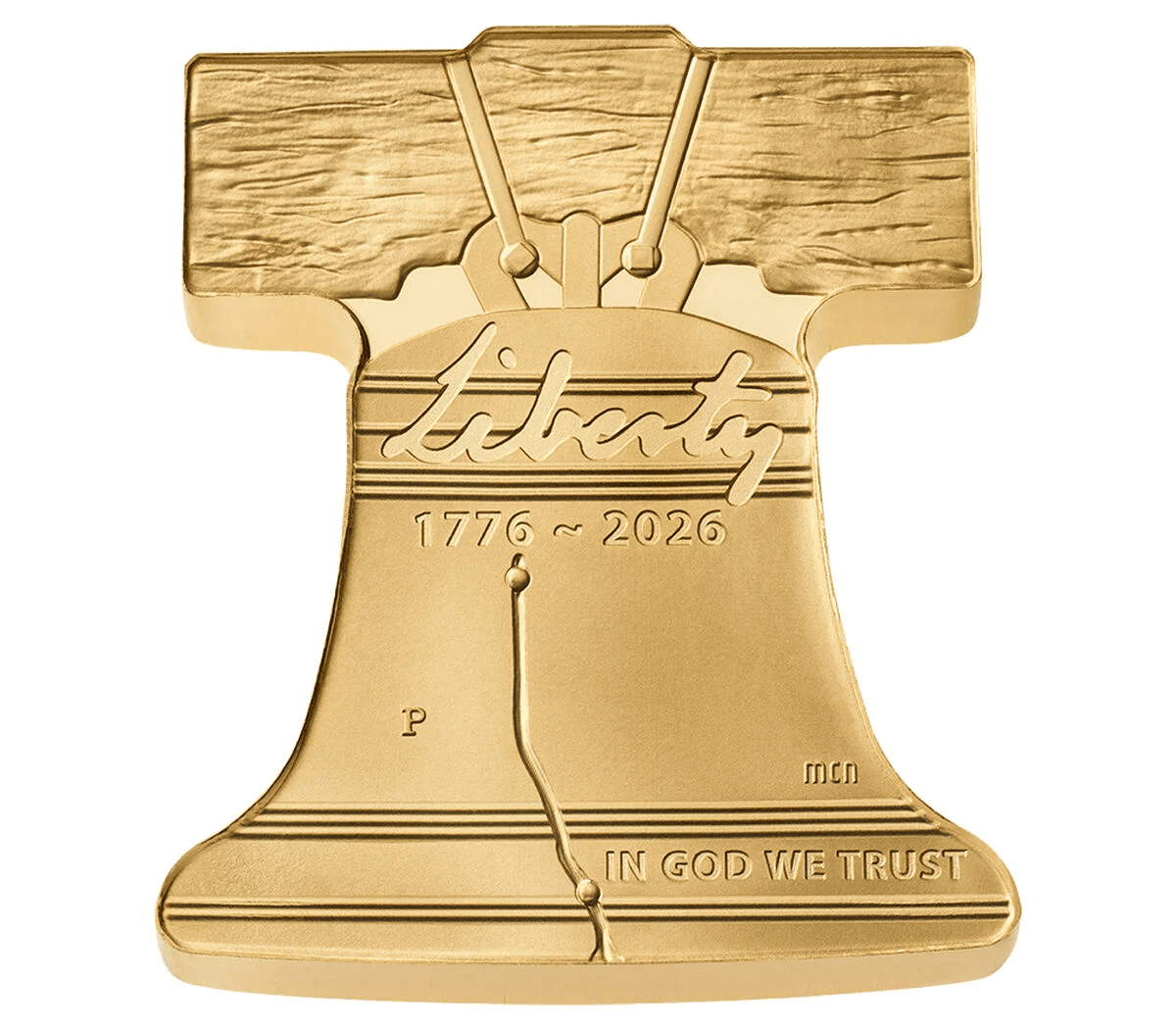
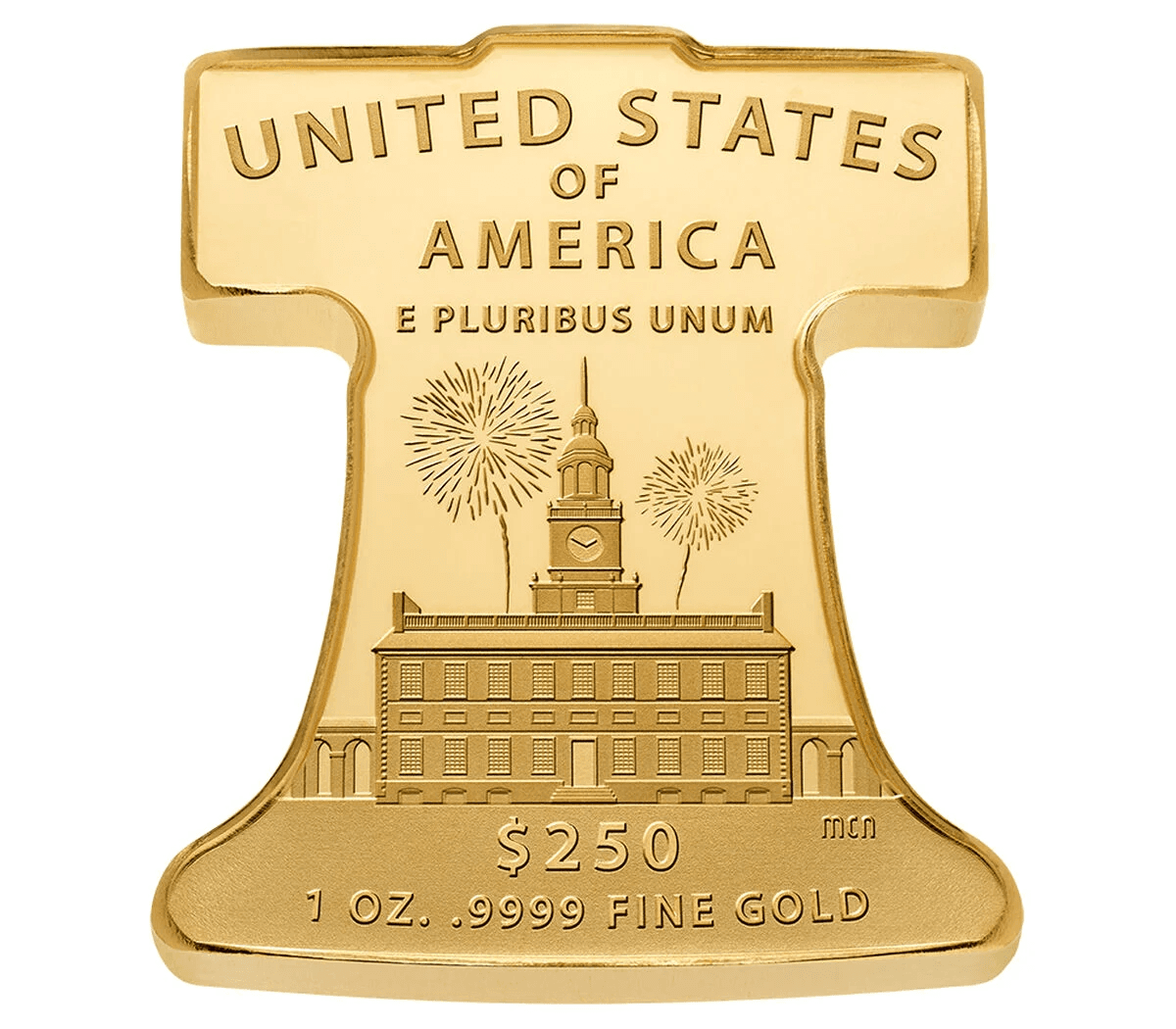
The bell also nods to its own inscription, the timeless line cast into the original: "Proclaim Liberty Throughout All the Land Unto All the Inhabitants Thereof."
The only precedent: 1915
The Mint describes the gold pieces as the first non-round coins in recent US history, and that qualifier is doing real work. The only earlier non-round coin the United States ever issued was the octagonal $50 gold piece struck for the 1915 Panama-Pacific Exposition in San Francisco. Its $50 face value was a steep ask at the time, sales fell short, unsold pieces were melted, and the net mintage settled at just 645 coins.
For more than a century that octagonal $50 stood alone as the only US legal-tender coin that broke the circle. The Liberty Bell gold coins are its first company, and the silver piece is the Mint's first non-round medal over the same stretch.
The three pieces in the series
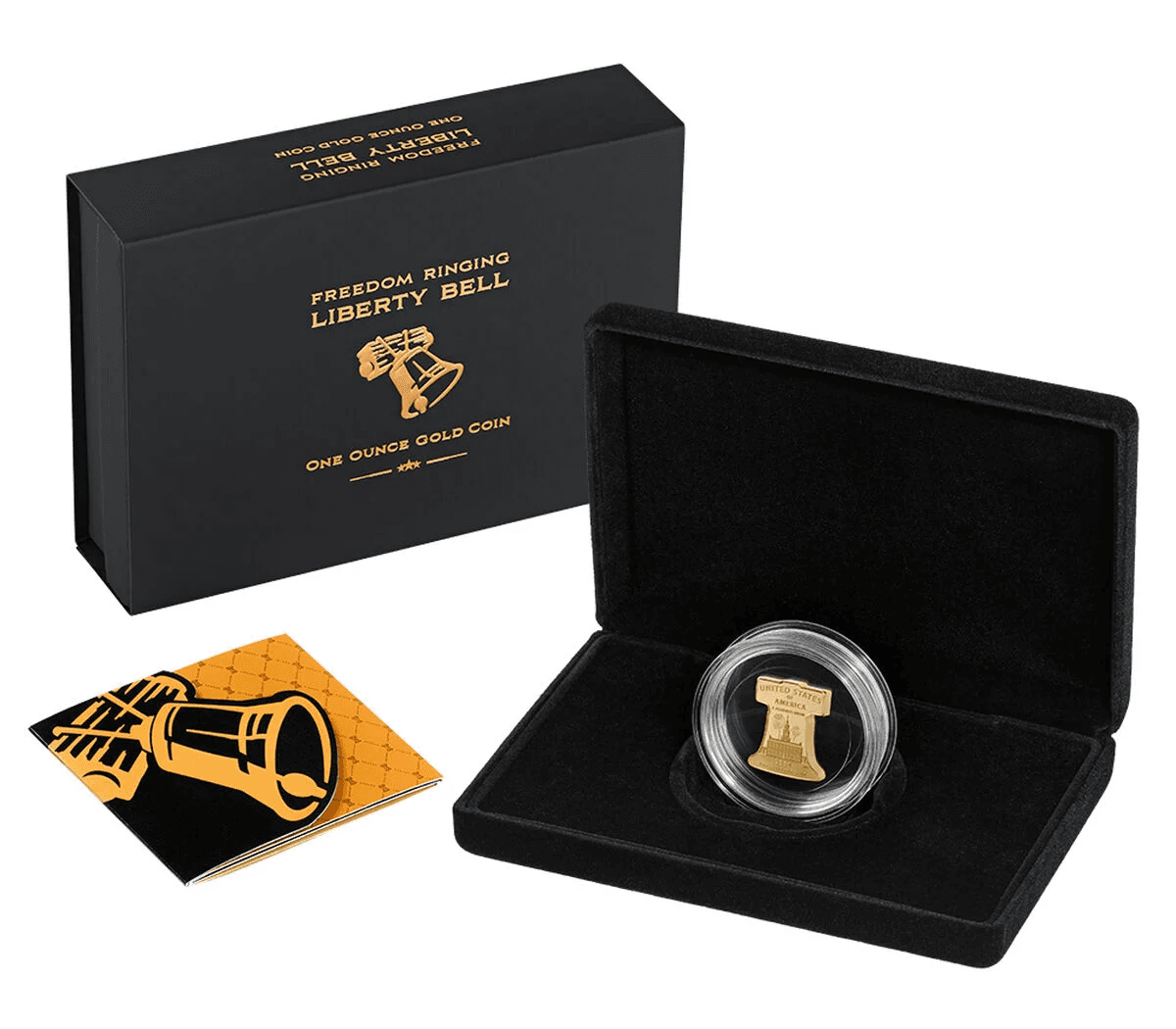
All three share the bell shape, the proof finish, and a mintage cap of 2,026 each:
One Ounce Gold Coin (Item 26LB): 1 oz, 99.99% gold. Face value $250.
One-Half Ounce Gold Coin (Item 26LC): 0.5 oz, 99.99% gold. Face value $125.
One-Half Ounce Silver Medal (Item 26LD): 0.5 oz, 99.9% silver. No face value (medal).
A note on that last one: the silver piece is a medal, not a coin, so it carries no face value. The design is the same bell on both sides of the series; the coin-versus-medal distinction is a legal-tender label, not a difference you can see.
Release details, briefly
Sales open Thursday, July 16, 2026 at 12:00 noon ET on usmint.gov, with a mintage of 2,026 per product and a one-per-household limit during the first 24 hours. Issue prices, the ordering process, and what happens if the Mint sells through are covered in the Freedom Ringing buyer and seller guide.
The bell pieces are the centerpiece of the Mint's 250th-anniversary lineup; the 2026 Semiquincentennial silver proof set is part of the same program.
Liberty Bell shaped coin: frequently asked questions
Is the Freedom Ringing - Liberty Bell the first non-round US coin?
It is the first in more than a century. The only earlier non-round US coin is the octagonal $50 gold piece struck for the 1915 Panama-Pacific Exposition, with a net mintage of 645. The Mint calls the Liberty Bell pieces its first non-round coins in recent history for that reason.
Why is the coin shaped like a bell?
The series marks the 250th anniversary of American independence, and the Mint chose the Liberty Bell silhouette, crack included, over putting the bell on a round coin. The shape is the point: it is the design element no other modern US issue has.
What do the designs show?
The obverse features the Liberty Bell with its famous crack, "LIBERTY" across the shoulder, and the dates "1776 ~ 2026." The reverse depicts Independence Hall framed by celebratory fireworks.
What is the difference between the coin and the medal?
The two gold pieces are legal-tender coins with face values of $250 and $125. The silver piece is a medal, so it has no face value and is not legal tender, but it shares the same Liberty Bell design and proof finish.
How many Freedom Ringing - Liberty Bell coins were minted?
Just 2,026 of each of the three products, minted for 2026 only. That is a tiny mintage compared with most US Mint releases.
Full specifications
Freedom Ringing - Liberty Bell One Ounce Gold Coin (26LB)
Finish: Proof
Composition: 99.99% gold
Gold fine weight: 1.000 troy ounce
Thickness: 0.167 inch
Length x width: 0.888 inch x 1.024 inches
Edge: Smooth
Mint: Philadelphia (P)
Face value: $250
Official listing: US Mint product page
Freedom Ringing - Liberty Bell One-Half Ounce Gold Coin (26LC)
Finish: Proof
Composition: 99.99% gold
Gold fine weight: 0.500 troy ounce
Thickness: 0.104 inch
Length x width: 0.883 inch x 1.024 inches
Edge: Smooth
Mint: Philadelphia (P)
Face value: $125
Official listing: US Mint product page
Freedom Ringing - Liberty Bell One-Half Ounce Silver Medal (26LD)
Finish: Proof
Composition: 99.9% silver
Weight: 0.500 troy ounce
Thickness: 0.160 inch
Length x width: 0.888 inch x 1.024 inches
Edge: Smooth
Mint: Philadelphia (P)
Face value: None (medal)
Official listing: US Mint product page